Natural GLP-1: the hormone you already make.
"Natural GLP-1" gets searched a lot, and it's usually misunderstood. GLP-1 isn't a drug — it's a hormone your own gut releases every time you eat. Here's what that means, whether you can support it naturally, and where salmon peptides fit — with the sources linked.
GLP-1 (glucagon-like peptide-1) is a natural hormone your body makes in the gut after a meal. It helps signal fullness and is part of how your body regulates appetite and blood sugar in the normal range. "Natural GLP-1" refers to supporting that hormone your body already produces — through food, protein, and certain peptides — rather than injecting a prescription version of it.1
On this page
GLP-1 is not a drug — it's a hormone you already make
This is the part most people get backwards. GLP-1 is a hormone your gut naturally produces after you eat. It's one of the "incretin" signals — messengers that tell your brain you're satisfied and help keep your blood sugar in a healthy range. You've been making GLP-1 your whole life.1
The reason the term feels drug-adjacent is that a class of prescription injections works by imitating this hormone. But the hormone itself is 100% natural and endogenous — your body's own.
"We're not mimicking hormones and we're not replacing them. The idea is to support the pathways your body already has."
So what does "natural GLP-1" actually mean?
When people search "natural GLP-1," they're usually asking one of two things: how do I get my own GLP-1 working better, or is there a way to support this without a prescription? Both come down to the same idea — encouraging your body's own GLP-1 signal rather than injecting a synthetic copy of the hormone.
Your body already turns GLP-1 up and down based on what and how you eat. Certain foods, protein types, and bioactive peptides have been studied for their effect on that natural release.
Can you support GLP-1 naturally?
To a degree, yes — this is well-established nutrition science. Your natural GLP-1 response is influenced by:
- Protein — protein-rich meals are among the strongest natural triggers of GLP-1 release.
- Fiber — fermentable fiber feeds gut bacteria that, in turn, prompt GLP-1.
- Whole, slower meals — how you eat affects the size of the signal.
- Certain bioactive peptides — the newest and most relevant area, below.
This is why "natural GLP-1 support" isn't hype in principle — the hormone genuinely responds to diet. The open question is always how much, and for whom.
Where salmon peptides fit
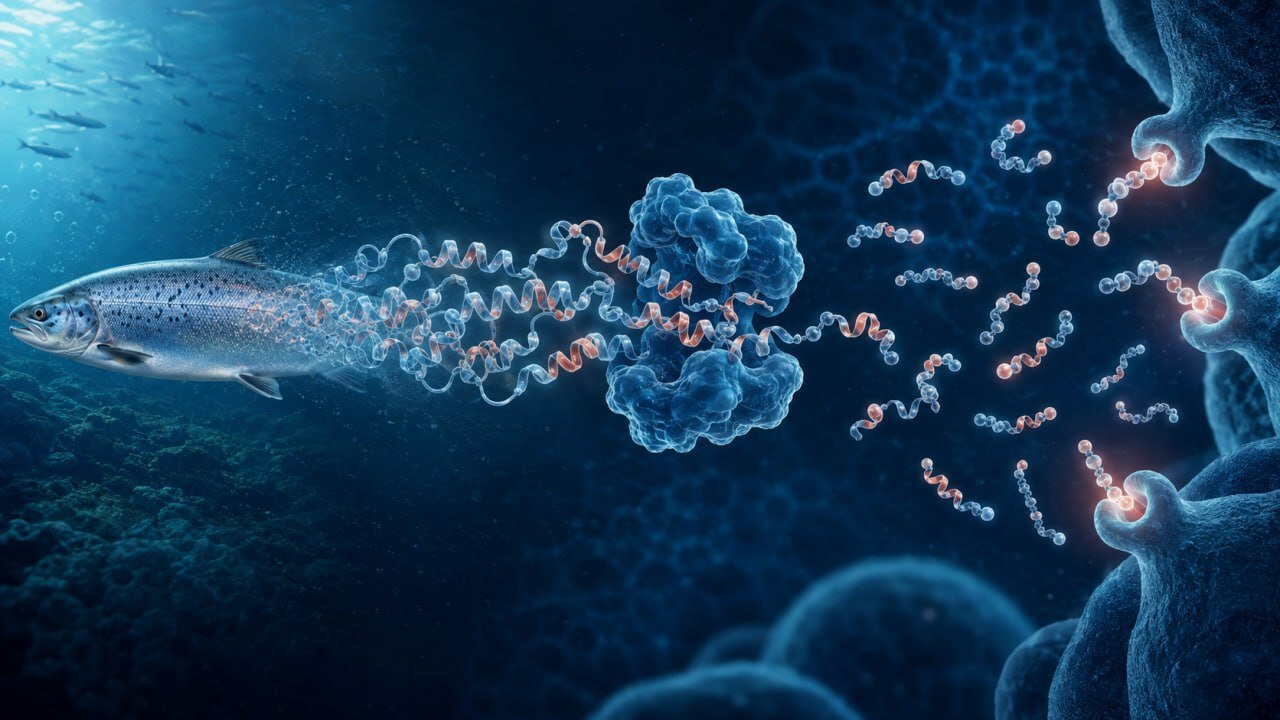
Here's the interesting research. In laboratory (cell-culture) studies, fish protein hydrolysates have been shown to increase the body's own GLP-1 secretion.2 Salmon-derived hydrolysates specifically enhanced GLP-1 release in gut-cell models.3 And in a small human study, a fish protein hydrolysate influenced appetite hormones including GLP-1 alongside changes in body weight and composition.4
That's the whole premise behind salmon-peptide drops: not to replace or inject GLP-1, but to support the pathway your body already runs. The suggested effective doses in the human literature on fish protein hydrolysates land in the range of roughly 1–6 grams per day.4
How this differs from the prescription shots
Two very different approaches often get blurred together, so here's the honest distinction — no product claims, just the mechanism:
- The injections deliver a synthetic molecule designed to imitate the GLP-1 hormone from the outside, at pharmaceutical strength. They're prescription drugs, prescribed and monitored by a doctor for specific medical uses.
- The natural / peptide approach is about nudging your body's own GLP-1 signal through diet and studied peptides. It's a dietary-supplement lane — gentler, not a drug, and not a substitute for medical treatment.
Which is right for a given person is a personal and medical decision. We're not here to tell you the shots are wrong — only to explain the natural side clearly, because that's the part the internet muddles.
The natural-GLP-1 approach, in a drop
triGLP is bioactive salmon peptides in four clean, sublingual ingredients — built to support the GLP pathways your body already has, not override them.
See the triGLP drops// ships from the official ORYGN storefront · dietary supplement · not a drug · results vary
The honest limits
Much of the salmon-peptide GLP-1 research is in cell cultures or animal models, and the human studies are small and preliminary. Encouraging signals in a lab are not proof of a result in any individual. Salmon peptides are a dietary supplement, not a medicine — they are not a treatment for diabetes, obesity, or any disease, they don't replace prescription care, and individual results vary. If you're managing a health condition or considering GLP-1 medication, that's a conversation for you and your own judgment. We link the studies so you can read them directly.
Common questions
Is GLP-1 natural or a drug?
GLP-1 itself is a natural hormone your gut produces after eating. The confusion comes from prescription injections that imitate the hormone — those are drugs, but the GLP-1 in your body is entirely natural and endogenous.
What is a natural GLP-1 supplement?
It's a supplement intended to support your body's own GLP-1 signaling — for example, through bioactive peptides studied for stimulating natural GLP-1 release — rather than delivering a synthetic version of the hormone. It's a dietary supplement, not a medication, and results vary.
Can food really raise GLP-1?
Yes — this is established nutrition science. Protein-rich meals and fermentable fiber are among the strongest natural triggers of GLP-1 release. How much varies by person and meal.
How do salmon peptides relate to GLP-1?
In laboratory and small human studies, fish and salmon protein hydrolysates have been shown to stimulate the body's own GLP-1 release. The aim is to support that natural signal — not to mimic or inject the hormone. See references 2–4.
References
- Bioactivities, Applications, Safety, and Health Benefits of Bioactive Peptides From Food and By-Products: A Review. Frontiers in Nutrition, 2021. frontiersin.org/articles/10.3389/fnut.2021.815640
- Blue Whiting Protein Hydrolysates Increase GLP-1 Secretion and Proglucagon Production in STC-1 Cells. Nutrients, 2022. ncbi.nlm.nih.gov/pmc/articles/PMC8877066
- Atlantic salmon (Salmo salar) co-product-derived protein hydrolysates: A source of antidiabetic peptides. Food Research International, 2018. sciencedirect.com/science/article/abs/pii/S0963996918300255
- Supplementation with a fish protein hydrolysate (Micromesistius poutassou): effects on body weight, body composition, and CCK/GLP-1 secretion. Food & Nutrition Research, 2016;60:29857. ncbi.nlm.nih.gov/pmc/articles/PMC4734037